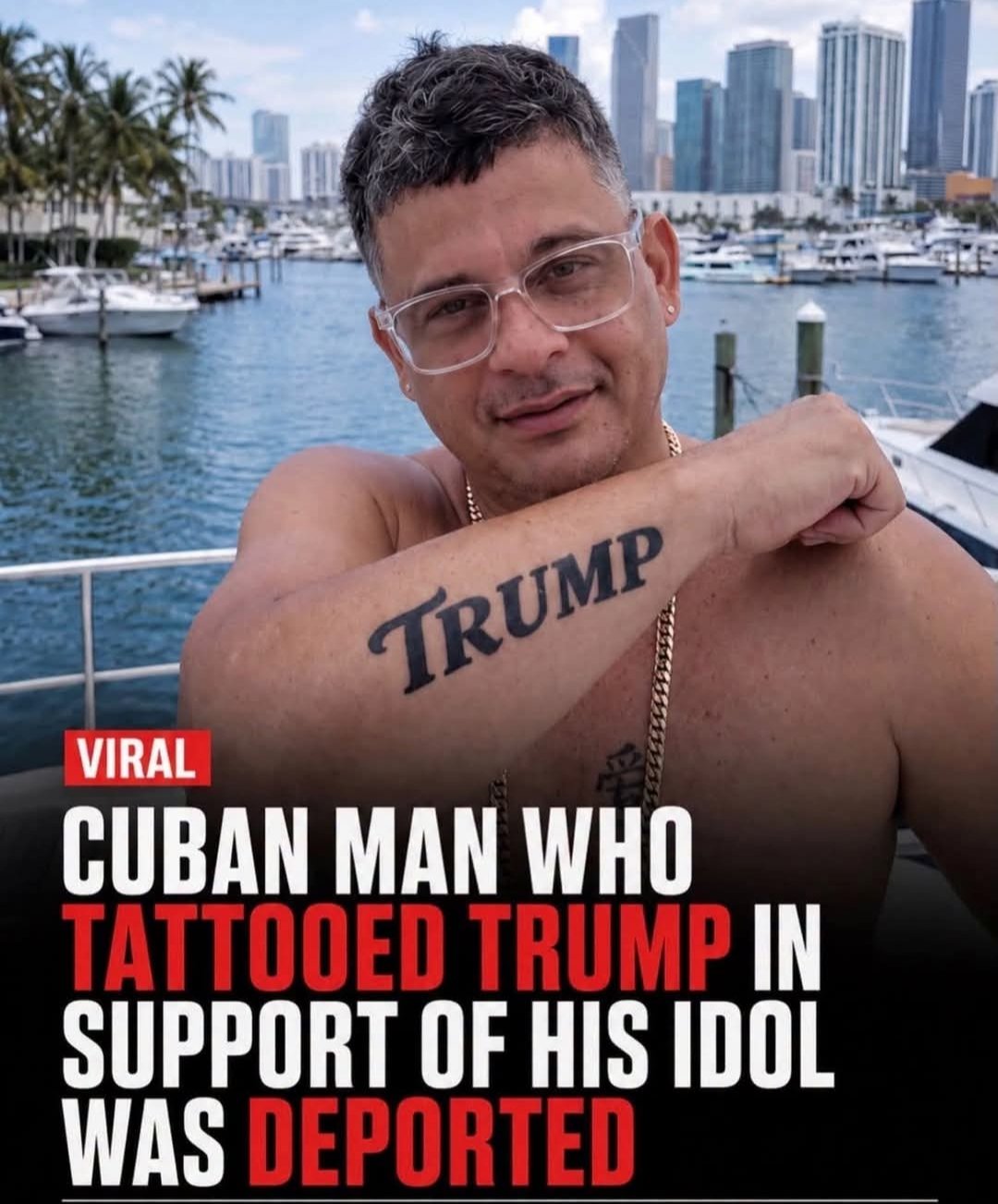
There is something almost painfully ironic about the image going viral online.
A Cuban immigrant proudly shows off a tattoo of “TRUMP” across his arm. He wasn’t quietly supporting Donald Trump. He put the president’s name permanently on his body.
Now, according to reporting, he is living with the fear that the very administration he supported could send him out of the country.
That is not just an internet meme.
It is a political lesson.
And it is a lesson that many Trump supporters may not want to hear.
He Believed Trump Would Help People Like Him
The man, known as “El Oski,” was profiled by Local 10 News in Miami. He is a Cuban immigrant who openly supported Trump and proudly displayed his Trump tattoo.
But when reporters spoke with him, the story was not that he had already been deported.
The story was that he was afraid he could be.
That distinction is important.
The viral posts claiming that the man in the photograph was already deported have not been backed by reliable evidence.
But there is a much more uncomfortable truth underneath the viral story.
His fear is real.
And the immigration crackdown he once supported is now creating uncertainty for people in circumstances like his.
That is where the irony stops being funny.
He Wanted Trump. Now He Has to Worry About Trump.
This is the part that should make people think.
Political campaigns are very good at making promises sound simple.
Build the wall.
Deport criminals.
Secure the border.
Put America first.
For many Trump supporters, those slogans can sound like they are aimed at someone else.
Someone who crossed the border yesterday.
Someone with a criminal record.
Someone who does not belong here.
But immigration enforcement does not operate according to campaign slogans.
It operates through paperwork, detention centers, immigration courts and government decisions that can dramatically change a person’s life.
And suddenly, someone who thought the immigration crackdown was about other people can discover that the government has questions about his own status.
That is apparently where this Cuban Trump supporter finds himself.
The man who literally tattooed Trump’s name on his body is now living with the consequences of the immigration politics he once embraced.
That is the irony the viral photograph captures.
The Cuban Immigration Story Is More Complicated Than Trump’s Slogans
Cuban immigrants have historically occupied a unique position in America’s immigration system.
For decades, Cuban migrants were given special treatment under U.S. immigration law, including a path toward permanent residency under the Cuban Adjustment Act for those who met its requirements.
But thousands of Cubans who arrived in the United States in recent years entered a much more complicated legal situation.
Many received I-220A paperwork rather than humanitarian parole.
That distinction may sound like bureaucratic fine print.
For an immigrant, it can mean the difference between having a viable path toward legal status and living in years of uncertainty.
The situation became even more frightening as immigration authorities began detaining some Cubans with I-220A documents, including people who had no criminal records.
For families who had spent years working, raising children and building lives in America, the message was suddenly very different.
You can be settled here.
You can have a job.
You can have a family.
You can have a life.
And still not know whether the government will let you stay.
This Is the Part Trump Supporters Should Have Seen Coming
There is a certain political fantasy that comes with aggressive immigration enforcement.
The idea is that the government can simply identify the “bad people,” remove them and leave everyone else alone.
Reality is messier.
Immigration cases are complicated.
People have different documents.
People have different legal histories.
People have pending applications.
People have court cases.
People have children who are American citizens.
And some people who believed they were safe suddenly discover that they are not.
That is why the story of the Trump tattoo is so powerful, even if the viral claim about his deportation is not true.
He appears to have believed in Trump’s immigration promises. Now he is discovering that immigration enforcement is not an abstract political slogan.
It can come directly to your door.
And the Deportations Are Not Imaginary
While the viral claim about this particular man remains unverified, the broader deportation campaign is very real.
Cuban immigrants have been detained and deported under increasingly aggressive immigration enforcement policies.
Third-country deportations have also become part of the administration’s strategy.
In one reported case, a Cuban man from South Florida said he spent months in immigration detention before being deported to the Central African Republic, a country he said he had never visited.
The government defended the removal as lawful.
That is not a meme.
That is a human being being placed on a plane and sent to a country he says he did not know.
And it illustrates the enormous power that the government has over the lives of people caught in America’s immigration system.
The Most Important Question Is Not Whether He Regrets His Vote
It would be easy to look at that photograph and laugh.
Maybe he regrets the tattoo.
Maybe he regrets supporting Trump.
Maybe he doesn’t.
But that is almost beside the point.
The real question is whether people should have to agree with the president to receive fair treatment from the government.
The answer should be obvious.
No.
If someone supports Trump, they should still have due process.
If someone despises Trump, they should still have due process.
If someone voted for Trump and later discovers that Trump’s immigration policies put their own future at risk, they should still have due process.
That is what separates a country governed by laws from a country governed by political loyalty.
There Is a Bigger Lesson Here
The image of a Trump supporter facing immigration uncertainty is satisfying to people who have spent years warning about Trump’s immigration policies.
It feels like poetic justice.
But there is something more important than poetic justice.
There are real people behind these policies.
Real families.
Real parents.
Real workers.
Real children.
Real lives that can be turned upside down by a government decision.
That is why Democrats should not simply celebrate when a Trump supporter gets caught in Trump’s immigration system.
The better response is to point out the contradiction.
You were told the crackdown would only affect someone else.
Then you discovered that the machinery of government does not care about your political loyalty.
It only cares about your immigration case.
The Tattoo Is the Perfect Symbol
The tattoo is almost too perfect.
“TRUMP” is permanently written across his arm.
It is a symbol of loyalty that cannot simply be deleted when the political winds change.
And now that same man is reportedly worried about whether the administration he supported will allow him to remain in the country.
There is a lesson in that.
Political movements are built on promises.
Government policies have consequences.
And sometimes those consequences reach the very people who believed they would never have to face them.
The viral story may not be that a Trump supporter was deported.
But the fact that he is reportedly afraid of deportation tells us something much more interesting.
He supported a political movement promising to make immigration enforcement tougher.
Now he is finding out what that promise looks like from the other side of the immigration system.
Don’t Just Laugh at the Photograph
Laughing at the tattoo is easy.
Understanding what it represents is harder.
The real story is not that a man tattooed Trump’s name on his arm.
The real story is that America’s immigration debate has consequences far beyond campaign rallies and social media posts.
And if this man is now afraid that the administration he supported could deport him, then perhaps he is learning a lesson that millions of Americans have been trying to explain for years.
Government power does not always stop where you think it will.
Today, it may be someone else.
Tomorrow, it may be you.
And no tattoo, no campaign slogan and no political loyalty can guarantee otherwise.
The meme is funny. The reality is not.