There are some departures that feel like ordinary changes in leadership.
And then there are departures that happen while a president is openly fighting with one of America’s most important cultural institutions over how the country should remember itself.
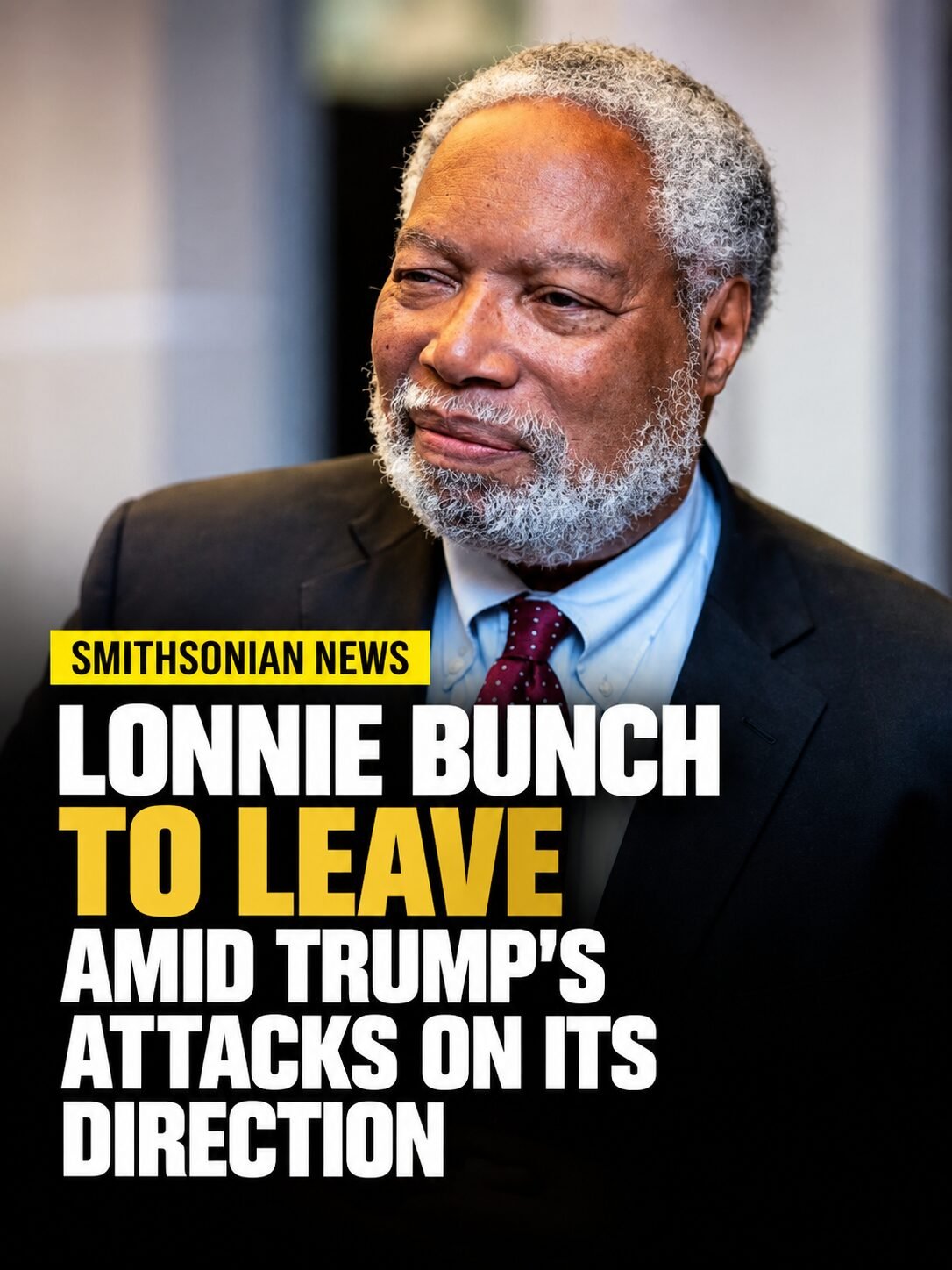
Lonnie G. Bunch III, the first Black person to lead the Smithsonian Institution, announced Tuesday that he will step down from his position by the end of the year.
Officially, Bunch is retiring.
But it is impossible to ignore the political storm surrounding the institution he has led since 2019.
The Trump administration has spent more than a year attacking the Smithsonian’s presentation of American history, accusing its museums of promoting what it calls a divisive and anti-American ideology. The administration has demanded changes to exhibitions, scrutinized educational materials and even threatened to withdraw federal support.
And now, as that pressure intensifies, one of the people responsible for protecting the Smithsonian’s independence is preparing to leave.
This Is About More Than One Museum Director
Lonnie Bunch is not simply another administrator leaving another government institution.
He is a historian.
He helped create the National Museum of African American History and Culture, one of the most significant cultural institutions in the country.
He spent nearly four decades working at the Smithsonian.
And as its secretary, he became the first Black person to lead an institution that tells the story of America to millions of people every year.
That makes the fight surrounding his departure especially significant.
Because the argument being made by the Trump administration is not simply about whether one particular exhibit could be improved.
It is about what Americans should be allowed to see, learn and remember about their own country.
Trump Doesn’t Like the Parts of History That Make Him Uncomfortable
Donald Trump has repeatedly complained that the Smithsonian spends too much time discussing slavery, racism and America’s failures.
He has argued that museums should focus more heavily on America’s achievements and successes.
There is nothing wrong with telling Americans about what this country has accomplished.
But there is a fundamental difference between celebrating America and sanitizing its history.
A country does not become stronger by pretending its darkest chapters never happened.
America did not become America without slavery.
It did not become America without segregation.
It did not become America without discrimination against immigrants, women and racial minorities.
And it certainly did not become America without generations of people fighting against those injustices.
That history belongs in America’s museums.
All of it.
The Smithsonian Is Not Supposed to Be a Trump Campaign Ad
This may be the most important point in the entire controversy.
The Smithsonian does not exist to make presidents feel good about themselves.
It does not exist to flatter Republicans.
It does not exist to flatter Democrats.
It exists to preserve and explain America’s history.
Sometimes that history is inspiring.
Sometimes it is embarrassing.
Sometimes it is heartbreaking.
Sometimes it is heroic.
Usually, it is all of those things at once.
That complexity is exactly what makes history worth studying.
But the Trump administration has increasingly treated uncomfortable history as though discussing it is somehow an attack on America.
That is a dangerous idea.
Patriotism Does Not Require Forgetting
There is a strange assumption behind the administration’s campaign against what it calls “divisive” history.
The assumption seems to be that acknowledging America’s failures somehow means hating America.
It doesn’t.
In fact, the opposite can be true.
You cannot genuinely love a country without being willing to understand it.
You cannot celebrate American democracy while refusing to discuss the people who were denied the right to vote.
You cannot celebrate freedom while refusing to discuss slavery.
You cannot celebrate equality while refusing to discuss segregation.
You cannot celebrate America’s promise while pretending that the promise was always available to everyone.
Knowing the truth about America is not anti-American.
It is one of the most patriotic things Americans can do.
And Lonnie Bunch Understands That
Bunch has spent his career making that argument through his work.
The National Museum of African American History and Culture was never intended to be a museum only for Black Americans.
Its purpose was to help the entire country understand a part of American history that had too often been pushed to the margins.
Bunch has described the goal as helping Americans understand their shared, complicated history.
That is precisely what museums should do.
They should make us think.
They should sometimes make us uncomfortable.
They should challenge the stories we were taught as children.
And they should give us enough evidence to decide for ourselves what kind of country we want to be.
Trump’s Pressure Has Been Impossible to Ignore
The administration’s campaign against the Smithsonian has not been subtle.
Trump signed an executive order directing officials to remove what he described as “improper” ideology from the institution.
The administration later demanded information about exhibitions, educational materials and other public-facing content.
In July, the White House released a lengthy report accusing the National Museum of American History of extreme political activism and arguing that the institution presents American history in a way that is too negative.
The administration has also threatened to cut off federal support for the Smithsonian.
And Trump has personally attacked the institution, complaining that its museums focus too much on slavery and America’s shortcomings.
That is an extraordinary amount of political pressure to place on a national cultural institution.
The Timing Should Make Americans Pay Attention
Bunch has said that Trump’s pressure was not the reason for his retirement.
He has explained that he had been considering stepping down for some time and wanted to spend more time with his family.
He is 73 years old.
After nearly four decades at the Smithsonian, he has certainly earned the right to decide when it is time for his next chapter.
But the fact that he is leaving at this particular moment still matters.
He is departing while the administration is attempting to reshape how one of America’s most respected institutions presents American history.
And whoever replaces him will inherit that fight.
What Happens After Bunch Leaves?
This is where Americans should be paying attention.
The Smithsonian has 21 museums, 20 libraries, the National Zoo and a vast network of research and educational programs.
Its influence is enormous.
Its collections belong to the public.
Its responsibility is to scholarship, not to whichever political party happens to control the White House.
That independence matters.
Chief Justice John Roberts, who serves as the Smithsonian’s chancellor, praised Bunch’s record and his commitment to telling the nation’s story.
That praise is significant because the Smithsonian is governed by a Board of Regents rather than simply operating as another arm of the White House.
The institution was designed to have a degree of independence from partisan politics.
It needs to stay that way.
America Does Not Need a Government-Approved History
Imagine a country where the government gets to decide which parts of history are patriotic enough to display.
Imagine museums being told that certain subjects are too uncomfortable for children.
Imagine exhibitions being rewritten because a president does not like the way a historical event makes America look.
That should concern Americans regardless of their political party.
Because once politicians are given the power to decide which historical truths are acceptable, there is no guarantee that the next administration will use that power the same way.
Today it may be slavery.
Tomorrow it could be immigration.
Then it could be the civil rights movement.
Then it could be women’s rights.
History becomes whatever the government in power says it is.
That is not education.
That is propaganda.
Bunch’s Legacy Is Bigger Than This Political Fight
Whatever happens next, Lonnie Bunch leaves behind an extraordinary legacy.
He helped create a museum that tells the story of Black America as part of the larger American story.
He became the first Black secretary of the Smithsonian.
And he spent decades arguing, through scholarship and public history, that America is strong enough to confront its own past.
That is an important message in an era when politicians increasingly want history to be comfortable.
History was never supposed to be comfortable.
It was supposed to be true.
The Smithsonian Must Outlast the Politics of Donald Trump
Presidents come and go.
Political movements come and go.
Culture wars come and go.
The Smithsonian should remain.
And the story it tells should not change simply because one president wants a more flattering version of America.
America is not made weaker by acknowledging slavery.
America is not made weaker by acknowledging racism.
America is not made weaker by acknowledging the discrimination suffered by immigrants and minorities.
America is made stronger when its citizens can look directly at those chapters and say: Yes, that happened. We know what it cost. And we choose to do better.
That is not an attack on America.
That is the American story.
Lonnie Bunch is leaving the Smithsonian.
But the question he leaves behind is much bigger than his retirement.
Who gets to tell America’s story?
The answer should never be the president alone.
It should be historians, scholars, curators and the American people.
Because the moment a government decides that history must make the country look good, history stops being history.
It becomes a political script.
And America deserves better than that.
“`2