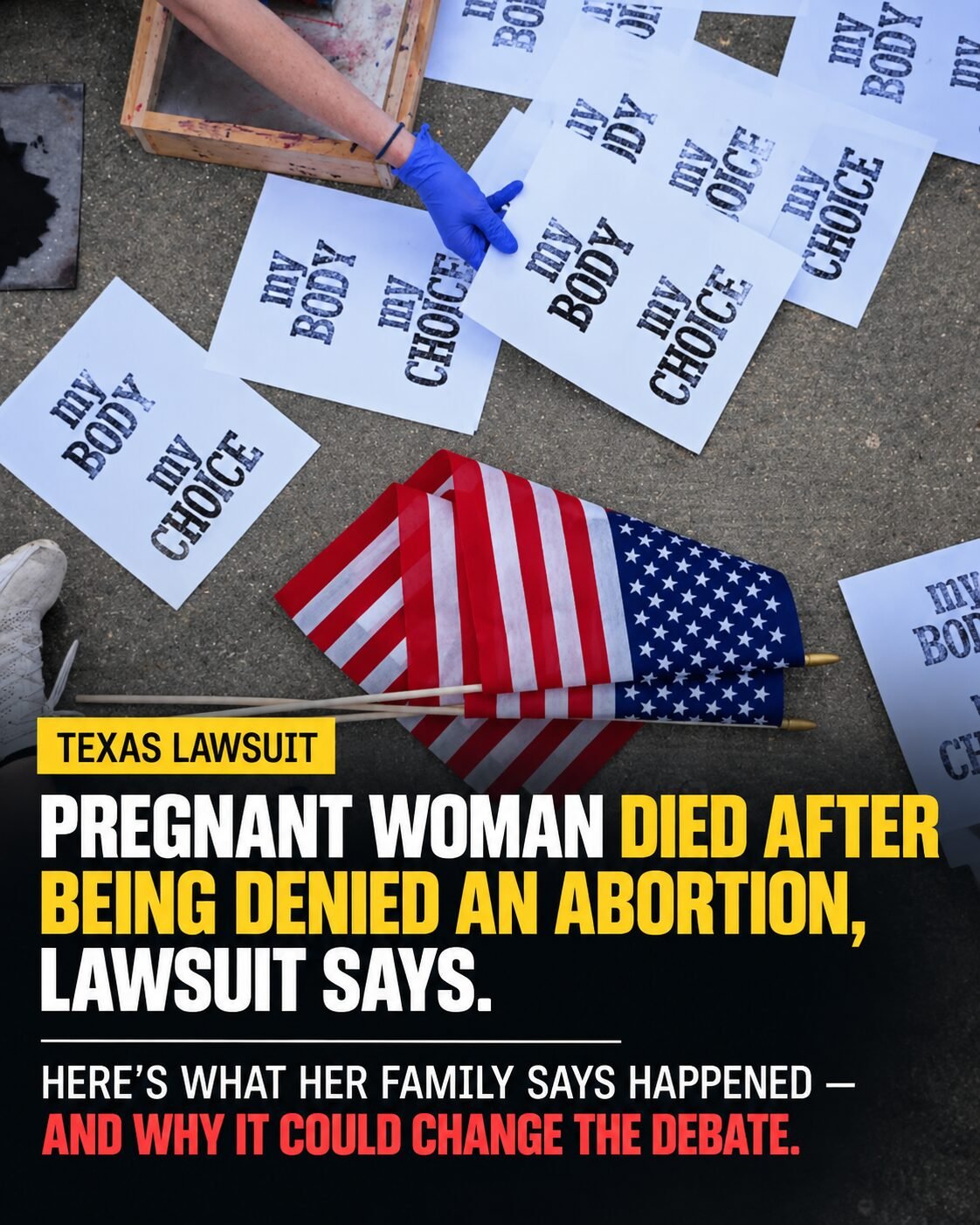
The family of a Texas woman who died during pregnancy has filed a lawsuit accusing the state’s restrictive abortion laws of contributing to her death.
The lawsuit, filed Tuesday in San Antonio, names Texas Attorney General Ken Paxton, the Texas Medical Board, the University of Texas Health Science Center at San Antonio and several doctors who treated the woman, Tierra Walker.
According to the lawsuit, Walker was 37 years old and about 20 weeks pregnant when she developed severe preeclampsia, a potentially life-threatening pregnancy complication involving dangerously high blood pressure.
She died in December 2024.
Her family alleges that doctors failed to provide an abortion even though, in their view, her condition qualified for an exception under Texas law.
The lawsuit argues that Texas’ abortion restrictions created an environment in which doctors were afraid to intervene until a patient’s condition became an unmistakable medical emergency.
Those are allegations made by Walker’s family in court. They have not yet been proven.
What Happened to Tierra Walker?
According to the complaint, Walker experienced symptoms associated with preeclampsia and visited a hospital multiple times.
Instead of receiving an abortion, the lawsuit says she was repeatedly sent home and told that her condition would improve.
Two days after her final hospital visit, Walker died.
The lawsuit says her death was caused by complications from preeclampsia and argues that ending the pregnancy could have prevented the fatal progression of her condition.
Severe preeclampsia can become life-threatening for a pregnant woman and may require delivery of the baby, depending on the circumstances and gestational age.
The lawsuit claims that Walker qualified for an emergency exception under Texas law but that the state’s restrictions and the fear of legal consequences influenced the medical decisions made in her case.
What Does Texas Law Actually Say?
Texas has some of the country’s most restrictive abortion laws.
The state’s abortion restrictions generally prohibit abortions after cardiac activity can be detected, with exceptions that include certain medical emergencies.
Texas law also contains provisions allowing abortion when a physician determines that it is necessary to save the pregnant patient’s life or prevent serious impairment of a major bodily function.
But determining exactly when an abortion qualifies under those exceptions has been the subject of intense legal and medical controversy.
Doctors have argued that the laws can leave them uncertain about how sick a patient must become before they can intervene without risking professional or legal consequences.
Supporters of the restrictions have rejected that characterization and have argued that Texas law allows doctors to perform abortions when necessary to save a patient’s life.
That disagreement is now at the center of another legal battle.
Texas Has Already Been Warned About This Problem
Walker’s case comes after several other high-profile legal challenges involving Texas’ abortion restrictions.
One of the most widely known cases involved Amanda Zurawski, who developed a serious pregnancy complication after doctors determined that her fetus would not survive.
Zurawski said she was forced to wait until she developed a life-threatening infection before doctors performed an abortion.
She spent three days in intensive care and suffered permanent damage that affected her ability to have more children.
In May 2024, the Texas Supreme Court rejected a challenge brought by Zurawski and other women who said they had been denied medically necessary abortions.
The all-Republican court ruled that Texas law allows life-saving abortions and said doctors would be mistaken if they believed the law required a woman’s death to be imminent before an abortion could be performed.
But the plaintiffs and their attorneys argued that the ruling failed to resolve the uncertainty doctors face in real-world emergencies.
Walker’s family’s lawsuit is now raising that same question in a different and potentially even more consequential setting.
The Fear Doctors Say They Face
Texas doctors who oppose the state’s abortion restrictions have repeatedly argued that the laws create an unusual problem in medical care.
Medicine does not always provide a precise moment when a patient crosses from “sick” into “dying.”
Pregnancy complications can develop quickly.
A doctor may know that a patient is deteriorating without knowing exactly when waiting becomes too dangerous.
That uncertainty becomes particularly important when doctors are also considering the possibility of criminal penalties, professional discipline or lawsuits.
Critics of Texas’ law argue that this can encourage doctors to wait until a patient’s condition becomes unmistakably life-threatening.
Supporters of the law argue that the medical exceptions are already broad enough and that doctors should not refuse lawful emergency care because of a misunderstanding of the statute.
The Walker lawsuit will put those competing arguments before a court once again.
The State Has Defended Its Abortion Restrictions
Texas Attorney General Ken Paxton’s office has defended the state’s abortion laws in previous cases and has argued that the statutes protect both mothers and unborn children.
In the earlier Zurawski case, Paxton’s office maintained that the law permits doctors to intervene when necessary to save a pregnant woman’s life.
Texas Right to Life, one of the groups that supported the state’s abortion restrictions, has similarly argued that doctors should act immediately when a genuine life-threatening emergency exists.
The central dispute is therefore not simply whether Texas law contains an exception.
It is whether that exception is clear enough for doctors to use confidently before a patient’s condition becomes catastrophic.
The Case Comes at a Larger Moment for Abortion Rights
Walker’s death is now part of a broader national debate that intensified after the U.S. Supreme Court overturned Roe v. Wade in 2022.
Since then, numerous states have enacted or maintained severe restrictions on abortion.
Texas is among the states with the strictest laws.
Supporters argue that those laws protect unborn life and reflect the policy choices made by elected lawmakers.
Opponents argue that abortion restrictions interfere with the doctor-patient relationship and can force women to continue pregnancies even when serious medical complications develop.
The Walker lawsuit presents a particularly difficult version of that debate because the question is no longer simply what the law should allow.
It asks what happened when a pregnant woman became seriously ill and whether the law influenced the medical decisions surrounding her care.
The Question Texas Cannot Avoid
There is a legitimate question at the heart of this case that goes beyond abortion politics.
How sick does a pregnant woman have to become before the government allows her doctor to intervene?
That question should concern people on both sides of the abortion debate.
Even people who strongly oppose abortion generally recognize that pregnancy can produce medical emergencies that threaten a woman’s life.
The disagreement is about where the law should draw the line and who should make that decision.
Should it be a legislature?
Should it be a judge?
Should it be a hospital lawyer?
Or should it primarily be the doctor treating the patient and the patient herself?
Opinion: When the Law Enters the Exam Room
There is something deeply unsettling about the circumstances alleged in this lawsuit.
Not because one lawsuit automatically proves that Texas’ abortion laws caused a death.
It doesn’t.
And not because every medical tragedy involving pregnancy can be blamed on abortion restrictions.
It cannot.
The details of Walker’s medical care will have to be examined in court.
But the case raises a question that deserves an honest answer from Texas lawmakers.
What happens when a doctor believes a pregnancy is becoming dangerous, but is afraid that acting too soon could expose them to legal consequences?
That is where the debate becomes less theoretical.
It becomes a question of who should control a medical decision during a rapidly developing emergency.
Republican lawmakers who support Texas’ abortion laws have emphasized that the statutes contain exceptions for life-threatening situations.
That is an important point.
But a law can contain an exception on paper and still create uncertainty in practice.
If doctors consistently believe they need to wait until a patient is closer to death before intervening, then lawmakers have a responsibility to examine why.
This Is Where Democrats Have a Stronger Argument
Democrats have generally argued that reproductive healthcare decisions should remain primarily between patients and their doctors rather than being dictated by politicians.
That position does not require anyone to believe that every abortion should be permitted under every circumstance.
It does, however, recognize something that Walker’s case makes painfully clear.
Pregnancy is not a mathematical equation.
Doctors often have to make decisions based on probabilities, changing symptoms and incomplete information.
A patient’s condition can deteriorate before anyone can say with absolute certainty that death is imminent.
Medicine deals in risk.
Law often wants certainty.
When those two systems collide, the patient can end up caught in the middle.
The Real Test Should Be What Happens Before It Is Too Late
Supporters of abortion restrictions often say that no woman should be denied life-saving medical care.
Critics say that promise means little if doctors are afraid to act until the danger becomes undeniable.
The only way to resolve that dispute is to examine what actually happens to patients.
Are doctors able to act when they reasonably believe a pregnancy is becoming dangerous?
Do hospitals understand exactly when the law permits intervention?
Are physicians receiving clear guidance?
And most importantly, are women receiving timely care before a medical complication becomes irreversible?
Those questions should not belong to Democrats or Republicans.
They belong to every patient who walks into a Texas hospital.
A Woman Should Not Have to Become a Medical Emergency
That may ultimately be the lesson of the Walker case.
Again, the allegations still have to be tested in court.
But if the family’s account is ultimately supported by the evidence, Texas lawmakers will have to confront an uncomfortable possibility.
A law designed to protect life may have created circumstances in which doctors hesitated to act while a woman’s condition deteriorated.
That is not a problem that should be dismissed as partisan politics.
It is a problem that should demand an answer.
Pregnancy already carries medical risks.
Patients should not have to wonder whether their doctor is treating their medical condition or calculating the legal consequences of treating it.
And doctors should not have to wait until a woman is visibly dying before they feel legally safe enough to save her.
The Lawsuit Now Forces Texas to Answer
Tierra Walker cannot tell her side of this story.
Her family is now trying to tell it for her in court.
The lawsuit does not establish guilt, and the defendants will have an opportunity to respond to the allegations.
But it raises a question that Texas cannot easily avoid.
If the state’s abortion laws are truly designed to protect women in medical emergencies, then patients and doctors should be able to understand exactly when those protections apply.
There should be no guessing.
No waiting for a patient’s condition to become catastrophic.
No uncertainty about whether providing emergency care could end a doctor’s career.
And no patient should have to become a cautionary tale before lawmakers decide that the rules need to be clearer.
The court will ultimately decide what happened in Tierra Walker’s case.
But Texas lawmakers still have a responsibility to ask whether their laws are working the way they intended.
Because when the stakes are a human life, clarity is not a political luxury.
It is a medical necessity.