I used to think you needed a huge front yard to make a home feel charming.
For the longest time, I’d scroll through Pinterest seeing these wide wraparound porches, giant flower beds, and perfectly curved walkways and quietly think, Well… that’s nice for people with actual space. Meanwhile, my own little front porch area felt awkward. Too small for “real landscaping,” but too empty to ignore.
One spring, I finally decided to stop treating my tiny front yard like a limitation and start treating it like a design challenge instead. And honestly? Some of the smallest changes ended up making the biggest difference.
What surprised me most was how cozy and intentional a small front yard can feel when every little detail has a purpose. A slim planter here. A climbing vine there. Even changing the shape of a pathway somehow made the porch feel more welcoming.
If you’re working with a compact space too, I promise there’s a lot you can do without spending a fortune or overcrowding everything. These are the ideas that genuinely stood out to me while experimenting with my own porch landscaping and researching small-space outdoor design.
1. Use Layered Planters Instead of Large Garden Beds

One of the first mistakes I made was trying to squeeze full flower beds into a narrow front yard. It just looked cramped.
What worked better was layering planters at different heights near the porch steps. I used:
- A tall planter with ornamental grass
- Medium pots with flowers
- Small trailing plants near the bottom
Suddenly the entrance had depth without eating up walking space.
I especially love this trick for tiny porches because it creates that lush “garden” feeling without permanent landscaping. And honestly, it’s easier to maintain too. I can swap plants seasonally without digging up the yard every few months.
2. Add a Narrow Curved Walkway

This sounds oddly specific, but changing a straight walkway into a gently curved one made my tiny front yard feel noticeably softer.
Straight lines can make small spaces feel rigid. A subtle curve tricks the eye a little and adds movement. Even if your yard is tiny, a slight bend using pavers or stepping stones can create a more thoughtful look.
I noticed this especially at sunset when pathway lights hit the curve. It somehow made the whole porch feel more custom and inviting.
3. Try Vertical Landscaping Around the Porch

When ground space is limited, going upward helps so much.
I started using vertical elements after realizing I had empty wall space beside my porch that I completely ignored for years.
Some easy options:
Wall-mounted planters
Perfect for herbs, flowers, or trailing greenery.
Climbing vines
A simple trellis with jasmine or ivy can completely soften a plain porch wall.
Hanging baskets
These work especially well near porch railings where floor space is tight.
The key is balance though. Too many hanging pieces can quickly feel cluttered in a small area. I learned that the hard way after hanging four baskets in one corner and making the porch feel like a garden center.
4. Frame the Porch With Symmetry

There’s something timeless about symmetrical landscaping around a porch.
Even modest homes look more polished when the entrance feels balanced.
I once visited a neighbor whose porch had:
- Two matching lanterns
- Two identical planters
- Simple shrubs on both sides
That was it. Nothing extravagant. But the whole front yard looked expensive and intentional.
Symmetry works especially well in smaller spaces because it reduces visual chaos.
5. Use Gravel for Low-Maintenance Texture
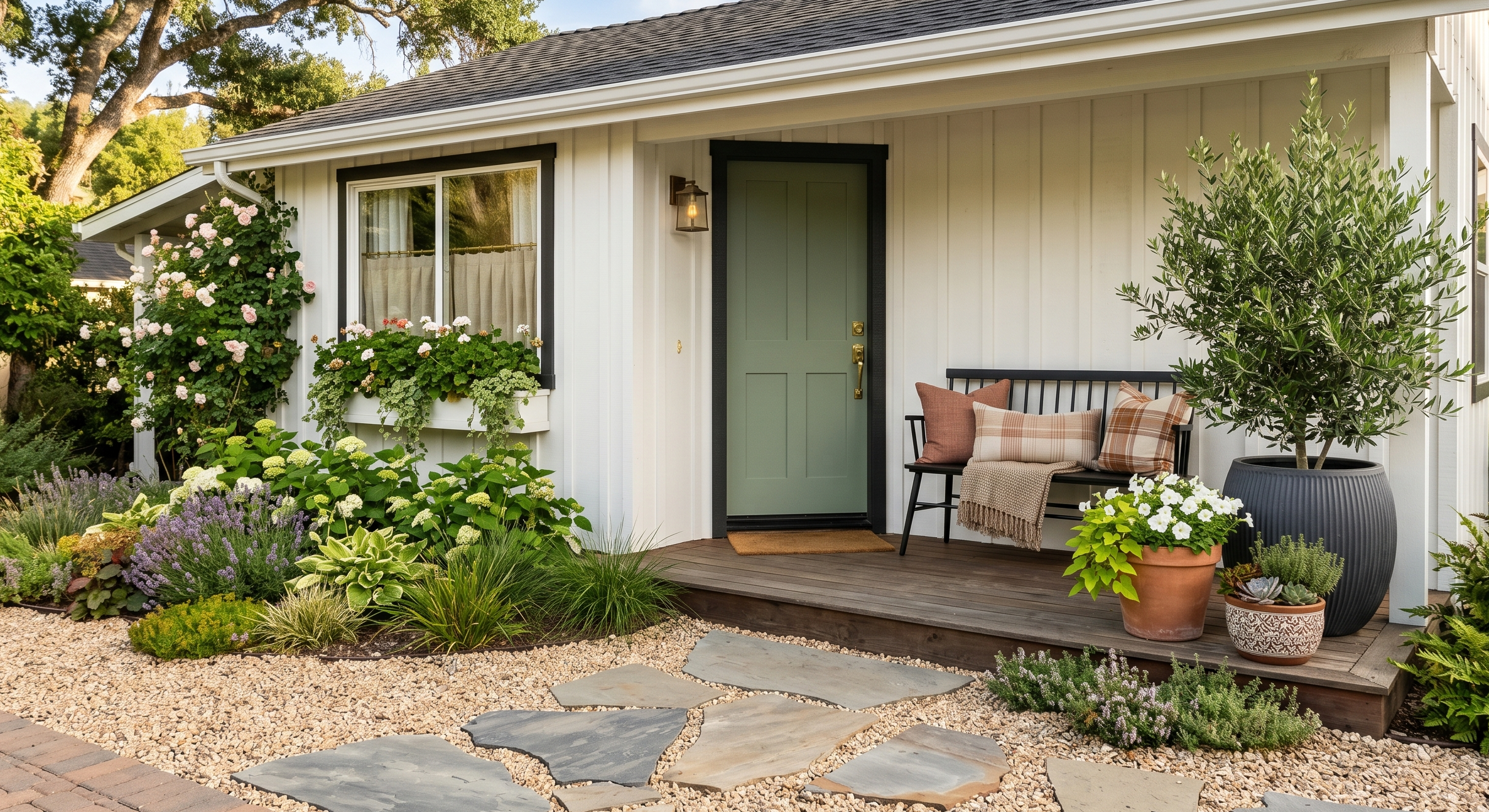
I underestimated decorative gravel for years because I associated it with boring side yards. Then I tried a small gravel section near my porch and instantly understood why designers use it constantly.
It adds contrast without overwhelming the space.
I personally like mixing:
- Gravel
- Potted plants
- A few larger stepping stones
It creates texture while keeping maintenance low. Plus, gravel drains well during rainy seasons, which mattered a lot for my front yard since water used to collect near the steps.
6. Plant Dwarf Shrubs Instead of Full-Size Bushes

This one probably saved me the most frustration.
Large shrubs may look beautiful at first, but in a small front yard they can take over surprisingly fast. I planted regular boxwoods once and within two years they made the porch feel hidden.
Now I stick to dwarf varieties whenever possible.
Some great small-space options:
- Dwarf boxwood
- Compact hydrangeas
- Mini spirea
- Dwarf loropetalum
You still get structure and greenery without constant aggressive trimming.
7. Add Porch Corner Gardens

Tiny unused porch corners are underrated.
I had one awkward corner near my steps where absolutely nothing fit properly. Eventually I turned it into a mini garden with:
- A tall ceramic pot
- Small white flowers
- One solar lantern
- A trailing vine
That tiny setup ended up becoming my favorite part of the yard.
Sometimes small landscaping works best when you stop trying to fill everything and instead create little moments that draw the eye naturally.
8. Use Lighting to Make the Yard Feel Bigger

This surprised me more than almost anything else.
Good lighting changes how spacious a small front yard feels at night.
I started with cheap solar lights along the walkway, then added warm wall sconces near the porch. The glow created depth that wasn’t noticeable during the daytime.
A few lighting ideas that work beautifully:
- Solar pathway lights
- Warm porch sconces
- Lantern-style step lighting
- String lights along railings
Warm lighting always feels cozier than overly bright white lighting in small spaces, at least in my experience.
9. Create a Tiny Flower Border Along the Porch

Even a narrow flower border can soften the entire front entrance.
One thing I learned is that flower borders don’t need to be deep to make an impact. Mine is barely over a foot wide in some places.
I planted:
- Lavender
- White alyssum
- Dwarf marigolds
- Creeping thyme
The mix added color without making the walkway feel crowded.
And honestly, having flowers right near the porch makes everyday moments nicer. Watering plants in the morning became strangely calming for me during stressful weeks.
10. Mix Modern and Cottage Elements

I used to think landscaping styles had to perfectly match.
Then I realized some of the prettiest small front yards mix clean modern lines with softer cottage-style plants.
For example:
- Black planters with wildflowers
- Structured pavers with trailing vines
- Minimal furniture paired with overflowing greenery
That contrast gives a porch personality. Too much perfection can actually make small spaces feel cold.
11. Use Built-In Bench Seating With Planters

If your porch allows it, built-in seating can save space beautifully.
A friend of mine added a slim wooden bench with planter boxes attached to both sides. It looked custom-made for the porch and eliminated the need for extra furniture clutter.
What I liked most was how functional it felt:
- Seating
- Storage
- Landscaping
- Decoration
All in one small footprint.
12. Keep the Color Palette Simple

I learned this after one unfortunate summer where I planted every flower color imaginable.
The result? Chaos.
Now I usually stick to:
- Greens
- Whites
- Soft purples
- Occasional pinks
A restrained palette makes compact landscaping feel calmer and more elevated. Small spaces get visually crowded faster, so simplifying colors really helps.
13. Add Mulch for an Instant Finished Look

This might be the least exciting tip here, but honestly it’s one of the most effective.
Fresh mulch immediately makes landscaping look intentional.
Whenever my front yard starts feeling messy or unfinished, adding new mulch somehow ties everything together again. Dark mulch especially makes green plants stand out beautifully around a porch.
And bonus — it helps reduce weeds and keeps moisture in the soil during hot weather.
14. Use Slim Raised Beds Near Railings

Raised beds don’t have to be huge.
I’ve seen narrow wooden raised planters placed directly along porch railings and they looked surprisingly high-end. They work especially well for:
- Herbs
- Small flowers
- Compact shrubs
- Decorative grasses
This idea is great if your soil quality is poor too. You get more planting control without major yard work.
15. Leave Some Empty Space

This one took me years to understand.
Not every inch of a small front yard needs decoration.
At one point I overloaded my porch area with plants, lanterns, signs, chairs, and extra pots trying to make it look “styled.” Instead, it felt stressful and crowded.
Once I removed a few things, the whole yard finally breathed.
Empty space matters. It allows the beautiful details to stand out.
Sometimes the best landscaping decision is simply knowing when to stop adding more.
Final Thoughts
Small front yard landscaping around a porch really isn’t about squeezing in as many plants or decorations as possible. At least, that’s not what ended up working for me.
It’s more about creating warmth. Little details that make the entrance feel cared for.
A soft pathway light. A planter near the steps. A climbing vine slowly wrapping around a trellis over time. Those small things change how a home feels when you walk up to it after a long day.
And honestly, smaller spaces can feel more personal because every choice becomes more noticeable.
If you’re staring at a tiny front yard wondering what’s even possible there, start simple. One planter. One flower bed. One cozy corner near the porch.
That’s usually how the best outdoor spaces begin anyway.