
The largest wildlife rescue organization in India has started using acupuncture to help elephants recover from chronic pain, nerve damage, and mobility issues after their years of captivity or hard labor.
Their veterinary team sought training in alternative medicine so the techniques could be used alongside conventional veterinary medicine and found they boosted recovery rates when the usual treatments proved inadequate.
Founded 30 years ago, Wildlife SOS now runs 12 rescue and rehabilitation centers across the country, including the Elephant Conservation and Care Centre in Mathura, where veterinarians were first introduced to the potential of acupuncture while searching for ways to help Bani (pictured above), an orphaned calf who was left paralyzed after a tragic accident.
Determined to restore her ability to walk, the team began exploring alternative healing methods—from ayurvedic oil massages to hydrotherapy. Their search eventually led them to Thailand and the ancient art of acupuncture.
There, they connected Dr. Porrakote Rungsri, a Veterinary Acupuncture Specialist at Chiang Mai University and Dr. Huisheng Xie, Founder of the Chi University of Traditional Chinese Medicine in the USA.
Under their guidance, Bani’s veterinarians learned the fundamentals of acupuncture and how this ancient practice could be adapted to treat various conditions in our resident elephants.
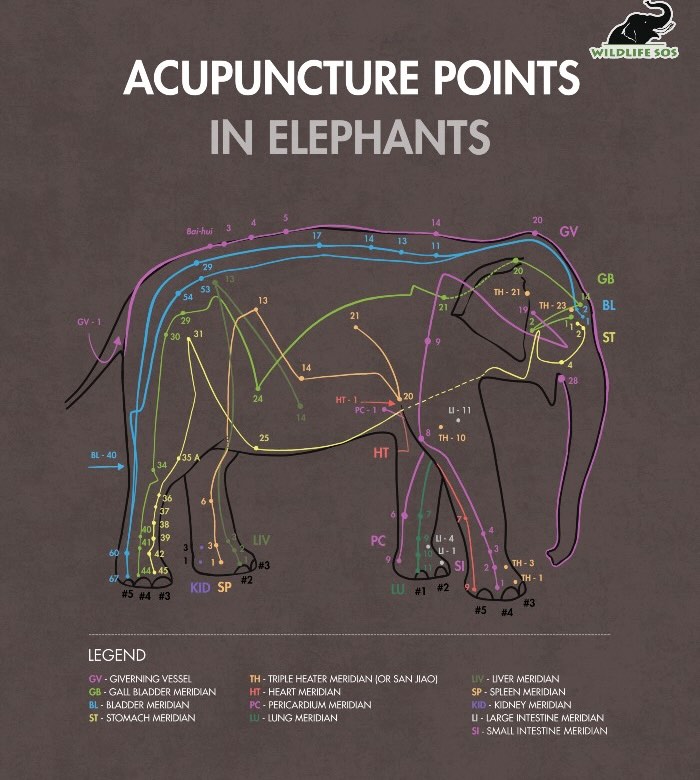
With roots tracing back 2,000 years, acupuncture tries to unblock the flow of energy through the body’s meridians, or energy channels. While the concept of invisible energy may sound abstract to many, its application of needles inserted along the meridians has shown practical benefits in veterinary—and human—medicine. By stimulating specific points along the body, acupuncture can help improve circulation, reduce pain, restore nerve function, and promote natural healing.
When the body is injured, damaged cells release chemicals such as prostaglandins, bradykinin, and substance P, which alert the nervous system. These chemicals activate nociceptors, special nerve sensors that convert the chemical signal into electrical signals. The pain signal is then carried by nerve fibers, and once the signal reaches the spinal cord, neurotransmitters in the brain interprets the signal, making pain both a physical and emotional experience.
“Many elephants rescued by Wildlife SOS have pain pathways overstimulated by years of abuse, poor nutrition, and untreated injuries, making chronic pain a major challenge to treat,” says the organization’s Natasha Ashok.
“Once our team gained expertise in acupuncture principles, we began applying it at our Elephant Hospital Campus, yielding remarkable improvements in several elephants.”
She says it has proven effective in alleviating pain, improving digestive issues (such as colic and constipation), and reducing inflammation in their elephants.
Chronic Pain and Arthritis in Holly and Zara
Many elephants rescued from exploitation, especially those used in the begging trade, suffer from severe joint and foot disorders such as osteoarthritis and stiff joints. These conditions are often the result of forced standing on hard surfaces or walking long distances on unnatural terrain.
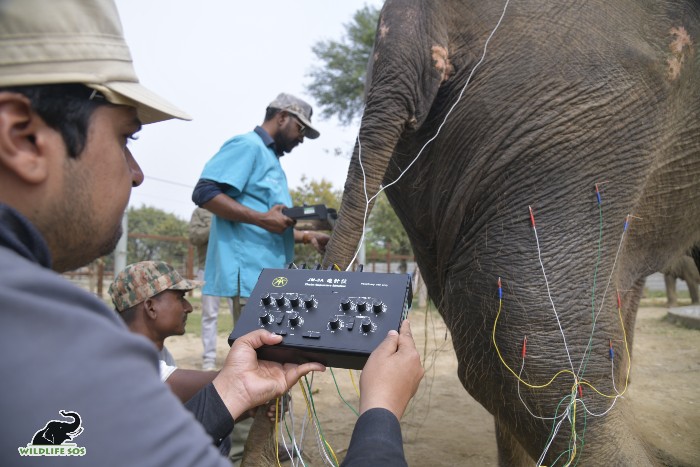
Two such pachyderms, Holly and Zara, experience chronic arthritis and severe hindlimb pain that makes walking difficult. To ease their discomfort, our team applied electro-acupuncture (pictured above) and dry needling.
For Holly, whose knee (stifle joint) was injured in a fall, veterinarians also used a method called ‘circle the dragon’, where needles are placed in a circular pattern around the joint. This technique improves blood flow, reduces inflammation, and encourages healing.
Colic and Digestive Issues in Raju and Taj
Raju and Taj were rescued from captivity, suffering from long-term digestive problems. Poor diets, unnatural feeding practices, and limited movement can result in conditions like colic and constipation that persist even after rehabilitation.
Raju struggled with recurrent colic, while Taj frequently experienced constipation. To support their recovery, veterinarians inserted fine acupuncture needles into acu-points related to digestion for about 20 minutes.
They also used ‘moxibustion’ with burnt mugwort to warm meridian pathways near the skin at specific points. The integrative approach stimulated circulation and promoted bowel movement and gut health, which helped improve their digestive function.
Another arrival at the Wildlife SOS center, Vayu, had ventral edema (an abnormal collection of fluid under the skin) in the perineal and abdominal regions, and the team treated points along his belly and chest with moxibustion acupuncture to improve circulation, helping reduce the edema.
“Acupuncture has become a valuable therapy that works well alongside modern veterinary medicine in ways previously thought impossible,” the group wrote. “Its integration has brought significant improvements.”
MORE GOOD ELEPHANT NEWS:
• Quick-Thinking Zoo Elephant Rescued a Drowning Gazelle with its Trunk (WATCH)
• Houston Elephants Do Yoga 7-days a Week to Stay Flexible and Healthy
• Elephant Fitted With a Prosthetic Foot So He’s Able to Walk Again – LOOK
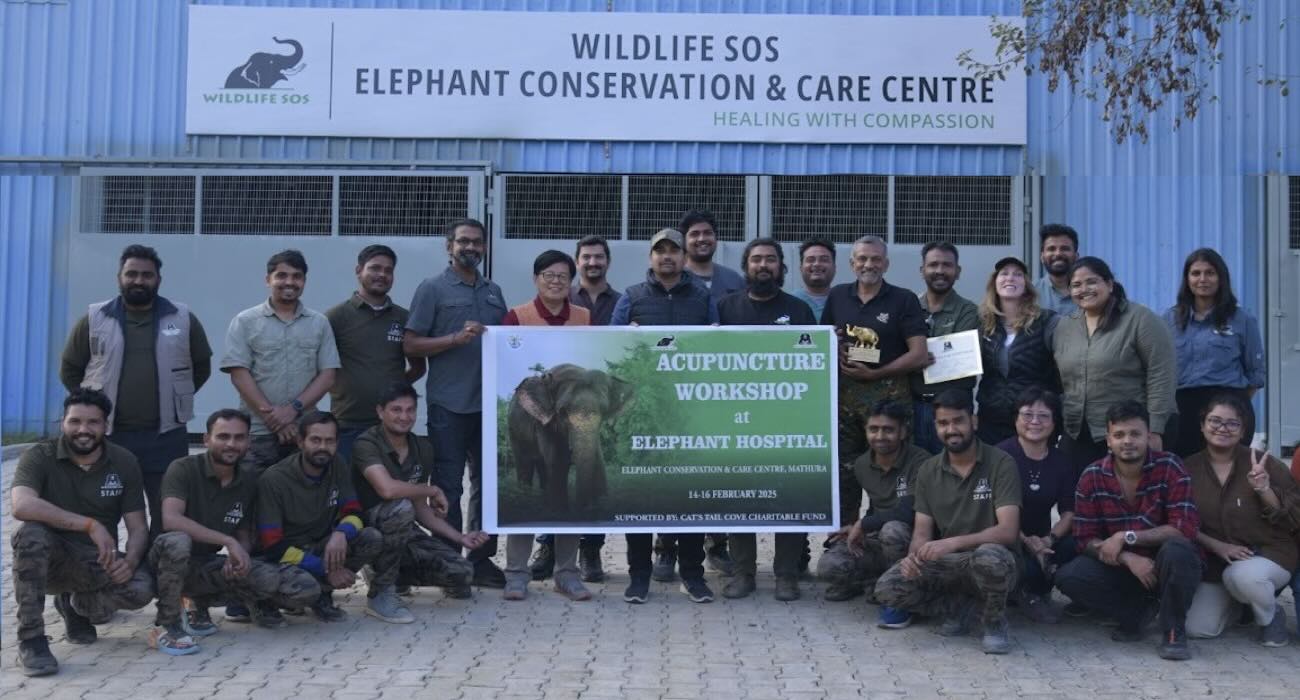
A year ago, Wildlife SOS held an elephant acupuncture workshop in their Mathura Care Center to get more people involved.
From baby Bani’s improving movement after paralysis to Holly, Zara, Raju, Taj, and Vayu gaining relief from debilitating conditions, these success stories affirm the power of combining holistic approaches appropriately with science-based treatments.
If you’d like to donate to care for these rescued elephants, visit their website.
SPREAD THE MOVING NEWS With Acupuncture Fans on Social Media…