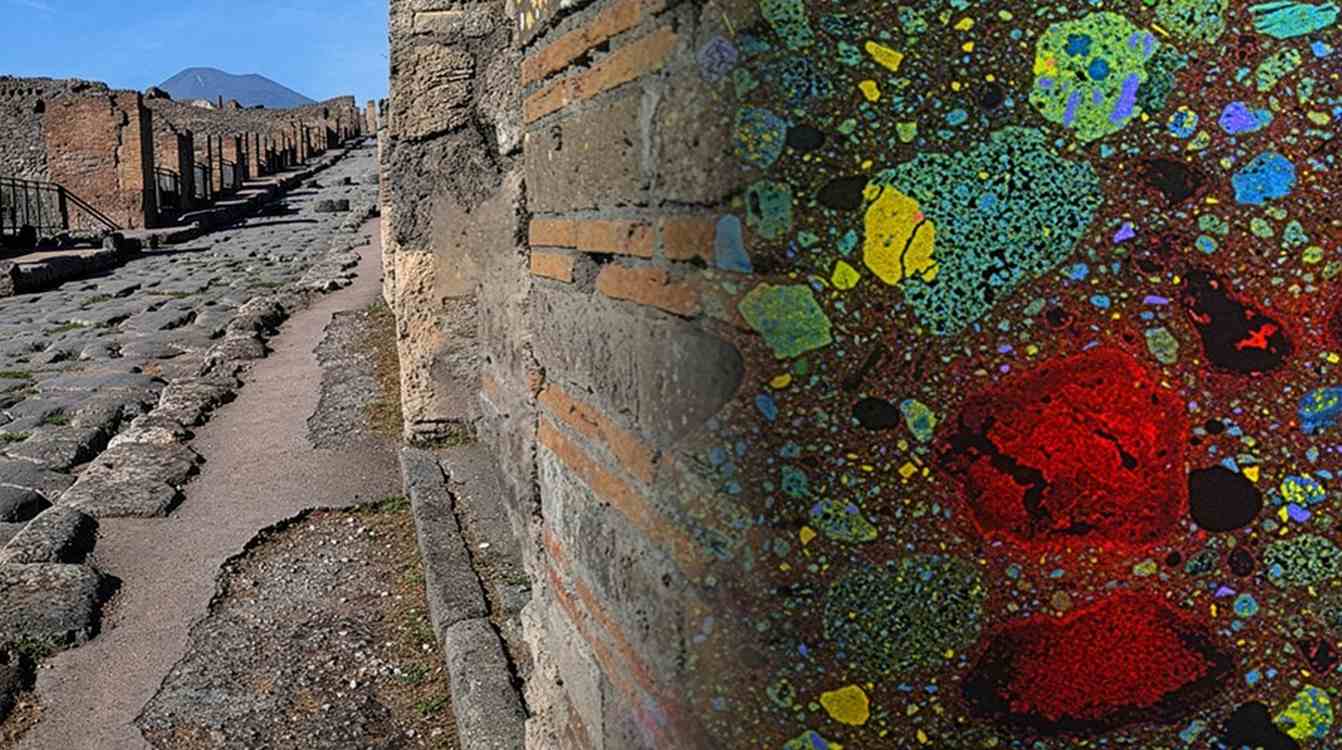
A scientist who figured out the secret behind ancient Rome’s self-repairing concrete has recently confirmed his theory at a Pompeii building site where such concrete was in use.
This marriage of theoretical and historical knowledge combined with hard evidence has inspired the very same scientist now 3 years later to open a concrete business selling the world’s most popular building material the way the Romans made it: built to last.
Concrete was the foundation of the classical Roman empire. It enabled Rome’s storied architectural revolution to produce large buildings, bridges, and aqueducts, many of which are still used some 2,000 years after their creation.
In 2023, MIT Associate Professor Admir Masic and his collaborators published a paper describing the manufacturing process that gave Roman concrete its longevity: lime fragments were mixed with volcanic ash and other dry ingredients before the addition of water.
Once water is added to this dry mix, heat is produced. As the concrete sets, this “hot-mixing” process traps and preserves the highly reactive lime as small, white, gravel-like features. When cracks form in the concrete, the lime clasts redissolve and fill the cracks, giving the concrete self-healing properties. GNN reported on the discovery at the time.
There was only one problem, MIT press reports, the process Masic’s team described was different from the one described by the famed ancient Roman architect Vitruvius. Vitruvius literally wrote the book on ancient architecture.
His highly influential work, De Architectura, written in the 1st century BCE, is the first known book on architectural theory. In it, Vitruvius says that Romans added water to lime to create a paste-like material before mixing it with other ingredients.
“Having a lot of respect for Vitruvius, it was difficult to suggest that his description may be inaccurate,” Masic said. “The writings of Vitruvius played a critical role in stimulating my interest in ancient Roman architecture, and the results from my research contradicted these important historical texts.”
Now, Masic and his collaborators are assuming Vitruvius was misinterpreted, after confirming that hot-mixing was indeed used by the Romans, a conclusion he reached by studying a newly discovered ancient construction site in Pompeii that was exquisitely preserved by the volcanic eruption of Mount Vesuvius in the year 79 CE.
They also characterized the volcanic ash material the Romans mixed with the lime, finding a surprisingly diverse array of reactive minerals that further added to the concrete’s ability to repair itself many years after these monumental structures were built, and revealing further the genius of Roman engineering.
MAKING EXISTING MATERIALS BETTER: Scientists ‘Cultivate’ Metal Instead of 3D Printing it–and it’s 20x Stronger
“There is the historic importance of this material, and then there is the scientific and technological importance of understanding it,” Masic explains. “This material can heal itself over thousands of years, it is reactive, and it is highly dynamic. It has survived earthquakes and volcanoes. It has endured under the sea and survived degradation from the elements.”
In his 2023 paper, Masic used samples from a city wall in Priverno in southwest Italy, which was conquered by the Romans in the 4th century BCE. But there was a question as to whether this wall was representative of other concrete structures built throughout the Roman empire.
The recent discovery by archaeologists of an active ancient construction site in Pompeii (complete with raw material piles and tools) therefore offered an unprecedented opportunity.
For the study, the researchers analyzed samples from these pre-mixed dry material piles, a wall that was in the process of being built, completed buttress and structural walls, and mortar repairs in an existing wall.
POMPEII REVEALING ITS SECRETS: Latest Digging from Pompeii Turns Up Large Private Spa Built to Spoil Wealthy Visitors
“We were blessed to be able to open this time capsule of a construction site and find piles of material ready to be used for the wall.”
The site offered the clearest evidence yet that the Romans used hot-mixing in concrete production. Not only did the concrete samples contain the lime clasts described in Masic’s previous paper, but the team also discovered intact quicklime fragments pre-mixed with other ingredients in a dry raw material pile, a critical first step in the preparation of hot-mixed concrete.
The researchers also analyzed the volcanic ingredients in the cement, including a type of volcanic ash called pumice—much of which pummeled Pompeii. They found that the pumice particles chemically reacted with the surrounding pore solution over time, creating new mineral deposits that further strengthened the concrete.
MAKING BETTER CONCRETE: Cement Supercapacitors Could Turn the Concrete Around Us into Massive Energy Storage Systems
Masic notes that calcium is a key component in both ancient and modern concretes, so understanding how it reacts over time holds lessons for understanding dynamic processes in modern cement as well. Towards these efforts, Masic has also started a company, DMAT, that uses lessons from ancient Roman concrete to create long-lasting modern concretes.
“This is relevant because Roman cement is durable, it heals itself, and it’s a dynamic system,” Masic says. “The way these pores in volcanic ingredients can be filled through recrystallization is a dream process we want to translate into our modern materials. We want materials that regenerate themselves.”
SHARE This Concrete Confirmation Of Rome’s Genius With Your Friends…