
If you’re a billionaire looking to jump into philanthropy there are hundreds of different causes to support.
Fans of the seemingly always-cash-strapped NASA will certainly be cheering after news that a former Google CEO is going to foot the bill for a modern, updated replacement to the Hubble Space Telescope.
The 3-decade-old observatory which gave so many individuals among the Millennial and Generation X demographics their first views of the cosmos is still operational, but struggles over funding priorities and a new focus on physical exploration rather than photographic exploration will undoubtedly see it retired in the coming years.
Eric Schmidt, CEO of Google from 2001 to 2011, and the company’s executive chairman from 2011 to 2015, has announced together with his wife Wendy that their estate will philanthropically fund 4 telescopic observatories, one of which, called Lazuli, will be launched into space and bring capabilities that would outclass Hubble.
“For 20 years, Eric and I have pursued philanthropy to seek new frontiers, whether in the deep sea or in the profound connections that link people and our planet, committing our resources to novel research that reaches beyond what might be funded by governments or the private sector,” Wendy Schmidt said in a statement to Ars Technica.
“With the Schmidt Observatory System, we’re enabling multiple approaches to understanding the vast universe where we find ourselves stewards of a living planet.”
Ars speculated that the total investment could reach half-a-billion dollars, while detailing that the 4 separate telescopes were drawn from existing designs proposed to NASA by scientists.
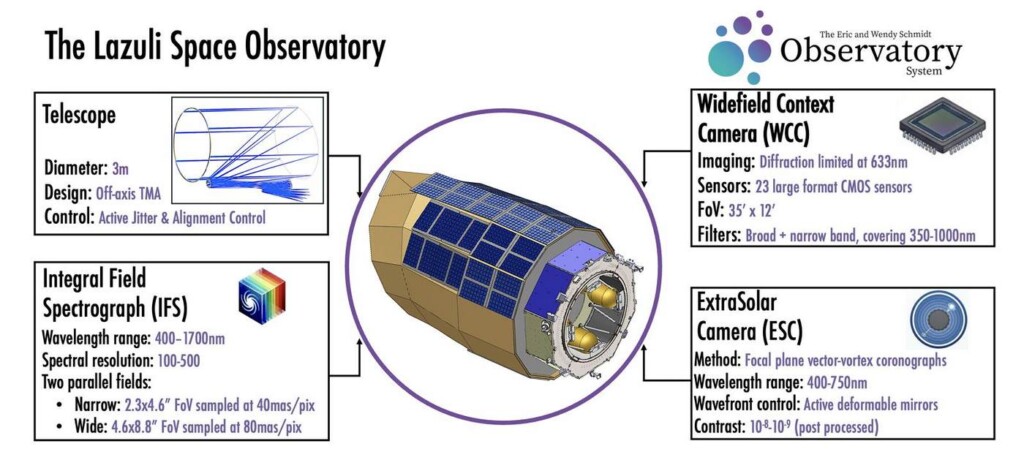
“We sit on decades of technological developments since Hubble,” said Arpita Roy, lead of the Astrophysics & Space Institute at Schmidt Sciences, in an interview. “Lazuli is a very modern take on Hubble, with a larger mirror, swifter response, and different instruments.”
Lazuli would, if built and launched, orbit the Earth just like Hubble, but where the latter has a primary mirror of 2.4 meters in diameter, Lazuli’s would measure 3.1. It would image the universe in optical light, or the wavelengths that our own eyes can see, and is intended to launch as early as late 2028 and begin scientific operations in 2029.
Another number larger than Hubble’s would be Lazuli’s average distance of orbit around the Earth, (275,000 km to 77,000 km). The farther away from our planet, the less interference from heat and light seeps into the final data and images.
GOOGLE GIVING: Google Turns 2 Billion Smartphones into a Global Earthquake Warning System
With more than 5 decades of telescope development to review, the President of Schmidt Sciences, Stuart Feldman, said the philanthropic organization will act alone to try and meet a 5-year deadline for design, construction, and launch, as well as to help better control costs.
Despite the spectacular end product, NASA and ESA’s efforts on the James Webb Space Telescope were famously slow and expensive, and it’s something that, along with considerations over shifting political priorities for the space agency, convinced the institute’s staff it would be better to take on the project themselves.
Feldman told Ars Technia he had “moderate-high confidence” of success.
GREAT PHILANTRHOPY: Walmart Heiress Opens Medical School with a Focus on Preventative Medicine
“We are taking far more risks than NASA would be willing to do,” he acknowledged. “But we are doing things rigorously, and aiming for a very high probability of success.”
For most of human history, all observatories were projects of philanthropy. The pre-modern world’s most advanced astronomical instrument was located in Samarqand, and was basically the pet-project of the sultan Ulug Beg, born to extreme wealth, luxury, and a fascination with the stars.
SHARE This Great Home-Grown Philanthropy Soon To Launch Into Space…